

How Much Space Do You Need For A Bounce House Or Water Slide is one of the most important questions to answer before choosing an inflatable for a birthday party, school event, family gathering, or other celebration. A bounce house or water slide may look like it will fit based on the listed dimensions, but the actual setup usually requires more room than the inflatable itself. The surrounding clearance, overall height, blower placement, entry and exit areas, ground surface, anchoring method, and delivery path can all affect whether a unit can be installed safely. When determining How Much Space Do You Need For Bounce House And Water Slide rentals, it is important to measure the usable setup area rather than simply looking at the total size of the yard. Fences, landscaping, trees, patios, slopes, overhead branches, utility lines, and other obstacles can reduce the amount of space that is actually available. Water slides may also require additional planning for electrical access, a nearby water source, and enough room around the landing or splash area. Measuring the complete setup area in advance can help you choose an inflatable that fits properly and avoid unexpected problems on delivery day.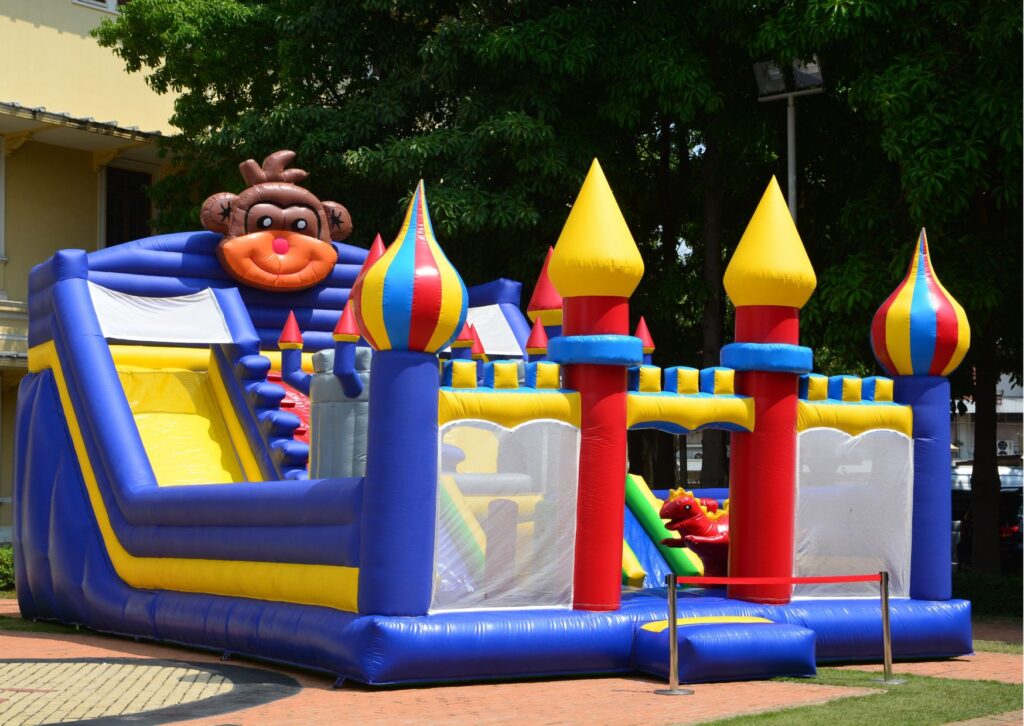
Quick Answer: How Much Space Do You Need for a Bounce House or Water Slide?
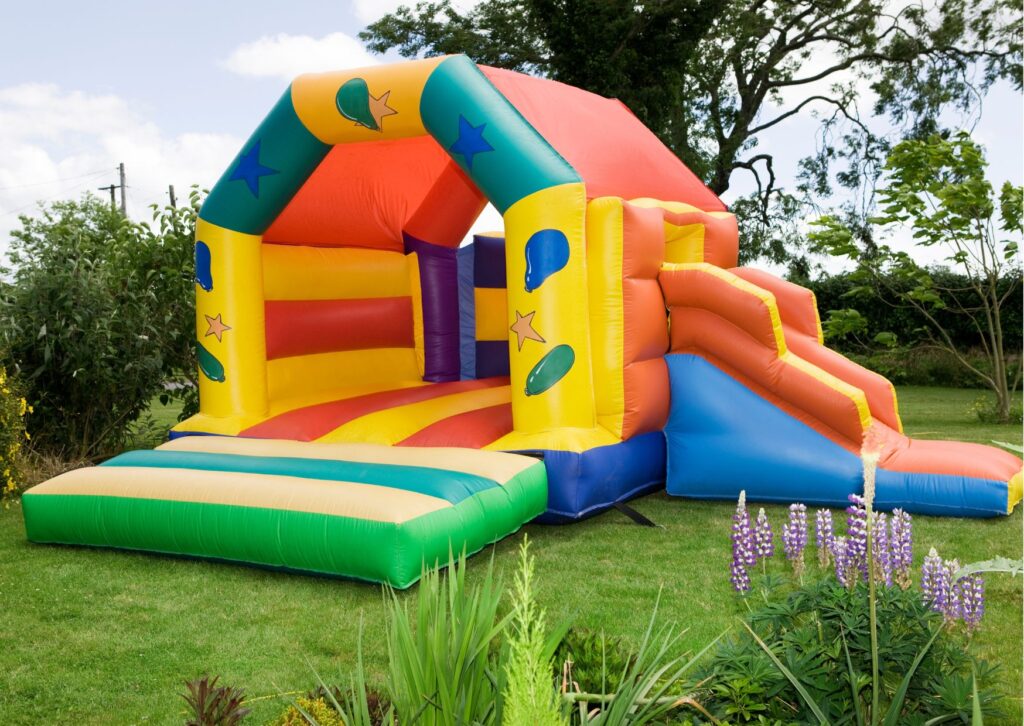
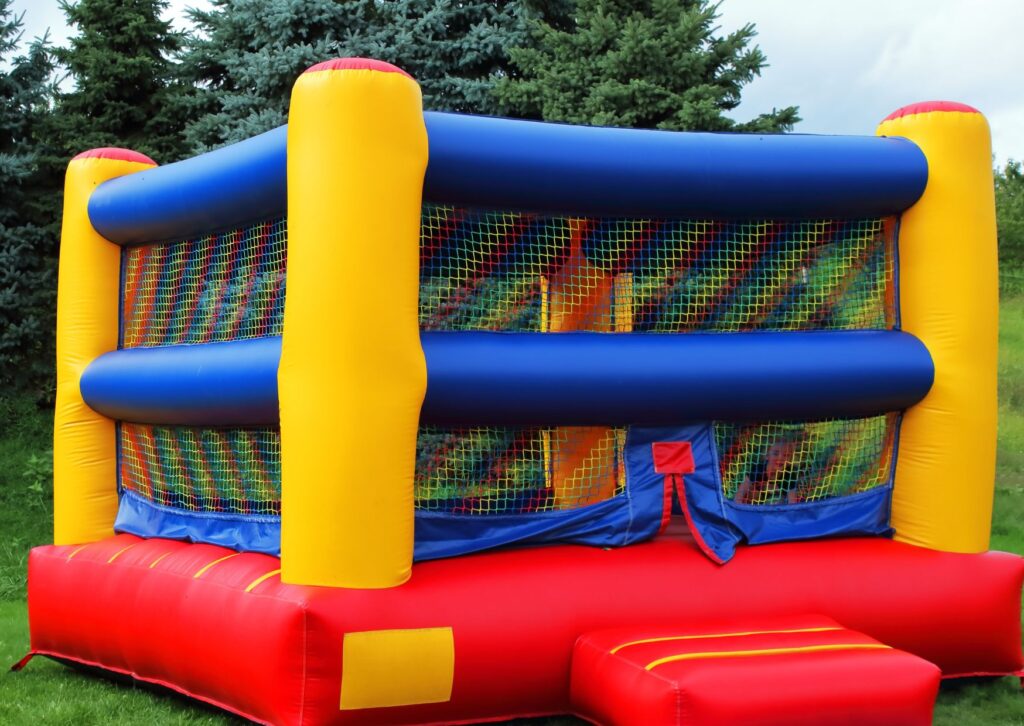
There is no single measurement that works for every bounce house or water slide because inflatables can vary widely in width, length, height, and overall design. A compact bounce house may fit comfortably in a smaller backyard, while a combination unit with an attached slide or a large water slide can require a much longer and wider setup area. The most important thing to remember is that the listed dimensions of the inflatable are only the starting point. The actual setup area usually needs to be larger so there is enough unobstructed space around the unit for safe operation, supervision, anchoring, the blower, and entry and exit areas. When people ask How Much Space Do You Need For Bounce Houses, the answer depends on the particular unit being considered. Standard bounce houses are commonly available in sizes such as 13 by 13 feet or 15 by 15 feet, but the clear setup area needs to extend beyond those dimensions. One source gives an example of a 13-by-13-foot bounce house requiring a minimum clear area of approximately 19 by 19 feet and a 15-by-15-foot unit requiring approximately 21 by 21 feet when surrounding clearance is included. Bounce house and slide combinations generally require more room because the slide extends the overall footprint and needs additional space at the landing area. A typical example in the source material is a combo unit measuring around 15 feet wide by 20 feet long, with the final clear setup area extending beyond those measurements.Typical Space Requirements at a Glance
Compact bounce houses are among the easiest inflatables to accommodate in smaller yards. One of the source articles describes compact 10-foot units that require approximately 12 to 14 feet of overall space in each direction once the necessary clearance around the inflatable is considered. Standard bounce houses are larger, with common examples measuring around 13 by 13 feet or 15 by 15 feet. Because the inflatable needs open space around its exterior, the actual setup area may be several feet larger on every side. This extra room helps prevent the inflatable from rubbing against fences, trees, buildings, landscaping, or other obstacles while also creating space for children and supervising adults to move around the unit. Combination units that include both a bounce house and a slide often measure around 15 by 20 feet, although exact dimensions vary. These inflatables need additional length because the slide and landing area extend beyond the main bouncing section. The landing area should also remain clear of walls, furniture, fences, and other hard obstacles. When considering How Much Space Do You Need For Water Slides, the available length of the setup area becomes especially important. According to one of the source articles, smaller standalone water slides may require approximately 15 to 18 feet of width and around 20 to 25 feet of length, while larger water slides can require substantially more space. Taller and double-lane slides may also need greater overhead clearance in addition to a larger ground footprint. Obstacle courses can require even more uninterrupted space because of their long layouts and extended landing or splash areas. For these larger inflatables, an open yard, field, school ground, park, or similarly spacious location may be more practical than a compact residential backyard. These measurements should be treated as planning examples rather than universal requirements. Every inflatable can have different dimensions, anchoring needs, clearance requirements, and setup conditions. Before booking, use the exact measurements and setup specifications for the unit you are considering and compare them with the usable area at your event location. This is the most reliable way to determine How Much Space Do You Need For Bounce Houses or How Much Space Do You Need For Water Slides without discovering a space problem on delivery day.Why the Inflatable Dimensions Are Not the Same as the Required Setup Space
One of the most common mistakes when planning for an inflatable is assuming that the listed dimensions tell you exactly how much room you need. A bounce house that measures 15 by 15 feet does not necessarily fit safely into a 15-by-15-foot section of a yard. The actual setup space needs to account for clearance around the inflatable, the blower and inflation tube, and any slide or landing area that extends beyond the main structure. This is why the answer to How Much Space Do You Need For Bounce House rentals is usually greater than the dimensions shown for the inflatable itself.The Safety Clearance Zone
The safety clearance zone is the open, unobstructed space surrounding the inflatable. One of the source articles describes a typical clearance of approximately 3 to 5 feet around standard inflatables, although the exact amount can vary depending on the unit. This space should remain free of fences, walls, trees, shrubs, patio furniture, vehicles, retaining walls, and other party equipment. Bounce houses are flexible structures, so the walls can move and bow outward while children are jumping inside. If the inflatable is positioned too close to a hard or rough surface, that movement can cause rubbing, punctures, or damage. The extra space also gives children a safer area to enter and exit while allowing supervising adults to move around the unit and monitor activity more easily.Leave Space Behind the Inflatable for the Blower
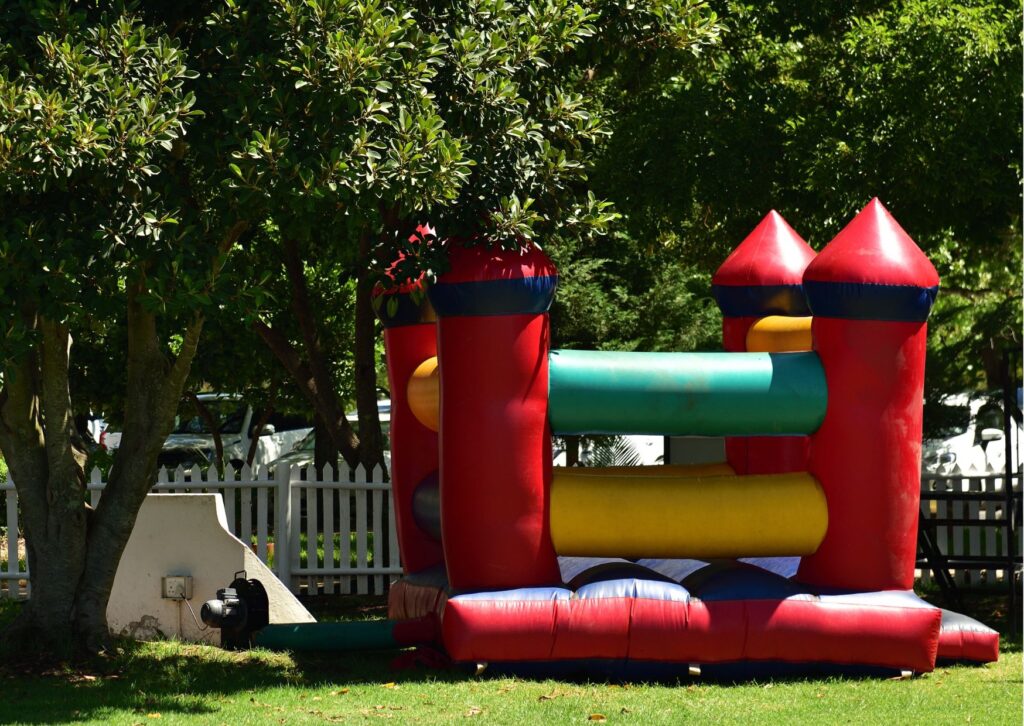
The rear of the inflatable also requires usable space for the blower and inflation tube. The blower continuously supplies air to keep the bounce house properly inflated, and the tube connecting it to the unit needs to remain open and relatively straight. If the inflatable is placed too close to a fence, wall, or other obstruction, the tube can become compressed or bent, which may restrict airflow and affect how well the inflatable stays inflated. For that reason, the area behind the unit should be included when calculating the total setup space rather than treated as unused space.Leave Extra Room Around Slides and Landing Areas
When determining How Much Space Do You Need For Bounce House Or Slides, it is especially important to consider the space at the end of the slide. The slide, splash pool, or landing area extends the functional footprint beyond the main bouncing section, so the entire length must be included in your measurements. The landing area should not end directly next to a fence, wall, table, landscaping feature, or other obstruction. Children need a clear area to finish the slide and exit safely without immediately encountering a hard object or crowded walkway. One source specifically notes that the slide landing area requires additional clearance, while another explains that splash pools can add extra length that must be factored into the total setup area. This extra room is one of the main reasons the required setup space is often noticeably larger than the inflatable dimensions listed on the rental description.How Much Space Do You Need for Different Types of Bounce Houses?
The amount of space needed for a bounce house depends largely on the size and style of the unit. Smaller inflatables are often designed for tighter residential spaces, while standard bounce houses require a larger clear area around the structure. In every case, the listed dimensions of the inflatable should be treated as the starting point rather than the final amount of space needed. The setup area must also allow room for the required perimeter clearance, the blower, safe entry and exit, and any anchoring equipment used during installation.Compact Bounce Houses
Compact bounce houses are a practical option for smaller backyards, patios, or event spaces where a full-size inflatable may not fit comfortably. One of the source articles describes compact units measuring around 10 feet and notes that they generally require approximately 12 to 14 feet of total space in each direction once the surrounding clearance is considered. When people ask How Much Space Do You Need For A Bouncy House in a limited yard, compact models are often the first type worth considering. Their smaller footprint can make them easier to position between fences, landscaping, and other permanent features. However, even a compact inflatable should not be placed directly against a wall, fence, tree, or piece of outdoor furniture. The usable setup area must extend beyond the inflatable itself so the structure has sufficient room around its exterior. This distinction is especially important in narrow residential yards. A space may appear large enough based on square footage alone, but the actual clear rectangle available for setup may be much smaller once landscaping, walkways, sheds, or other obstacles are taken into account.Standard Bounce Houses
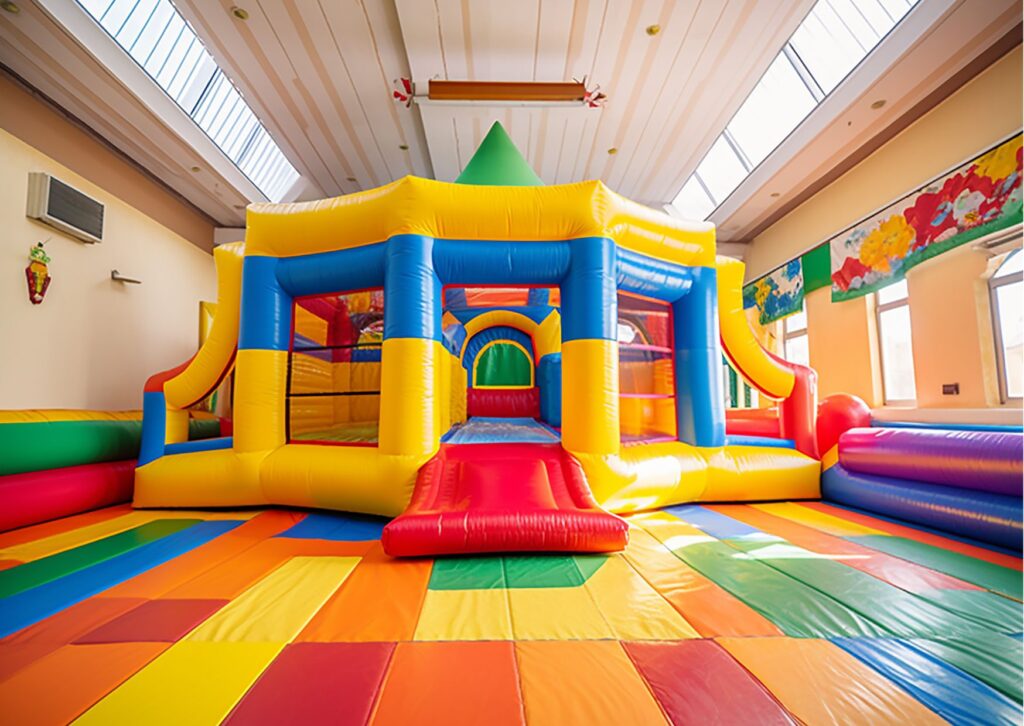
Standard bounce houses are among the most familiar inflatables used for birthday parties and family events. According to one of the source articles, common standard sizes include approximately 13 by 13 feet and 15 by 15 feet. The same source gives examples of a 13-by-13-foot unit requiring a clear setup area of about 19 by 19 feet and a 15-by-15-foot unit requiring about 21 by 21 feet when additional perimeter space is included. The key point is that inflatable size is not the same as required setup size. If a bounce house itself measures 15 by 15 feet, a 15-by-15-foot opening in the yard is not enough. The setup area must also include the clearance specified for that particular inflatable so the unit is not pressed against fencing, landscaping, buildings, or other obstacles. People searching How Much Space Do You Need For A Bouncer House are generally asking the same practical question: how large does the total clear setup area need to be? Likewise, the answer to How Much Space Do You Need For Bounce Houses depends on the exact model rather than a single standard number. Even two bounce houses with similar jumping areas may have different exterior features, entrance steps, decorative elements, or blower arrangements that affect their final space requirements. For that reason, the safest approach is to measure the clear area first and then compare those measurements with the complete setup specifications for the unit being considered.Bounce House and Slide Combo Units
Bounce house and slide combo units usually need more space than a standard bounce house because several activity areas are built into one inflatable. In addition to the main jumping section, these units may include a climbing section that leads to the slide, the slide itself, a landing area at the bottom, and in some cases a splash pool for wet use. The blower and inflation tube also need enough room behind the unit to operate properly. One of the source articles gives a 15-by-20-foot combo unit as a typical example, but the actual setup area will be larger once the required surrounding clearance is included. This is why the answer to How Much Space Do You Need For Bounce Houses And Water Slides depends on the complete shape and configuration of the inflatable, not just its listed width and length. Combo units often work best in a longer rectangular area so there is enough room for the bouncing section, slide path, and clear landing zone without crowding fences, walls, furniture, or other obstacles.How Much Space Do You Need for a Water Slide?
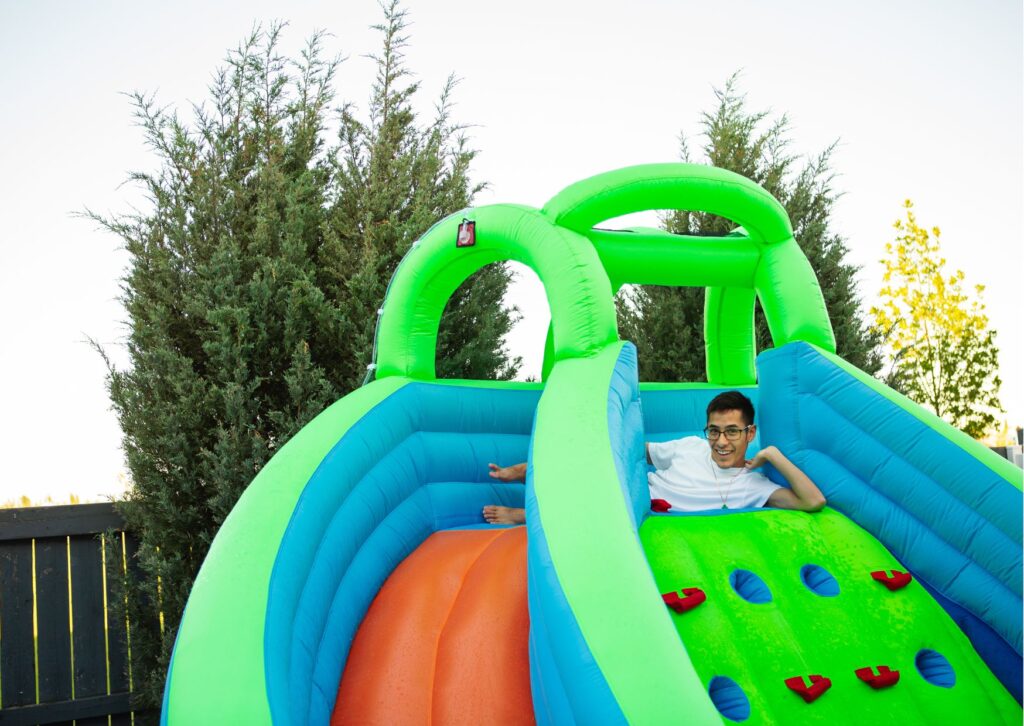
Water slides should be planned differently from standard bounce houses because their shape and setup needs are usually more elongated. While a bounce house often has a relatively square footprint, a water slide typically extends farther in one direction to accommodate the climbing section, slide lane, landing area, and sometimes a splash pool. That means the length of the available setup area can be just as important as the overall width. The source material notes that smaller standalone water slides may require approximately 15 to 18 feet of width and 20 to 25 feet of length, while larger units can require significantly more room. These figures are useful as planning examples, but they should not be treated as universal requirements because water slides can vary considerably in height, lane configuration, landing design, and overall footprint.Small and Standard Water Slides
When people ask How Much Space Do You Need For A Water Slide, the most important thing to understand is that the answer usually depends more on length than on a square footprint. Smaller standalone slides often need a long, clear setup area so the climbing section, slide lane, and landing zone can all fit comfortably in a straight line. One of the source articles gives smaller water slides as an example requiring roughly 15 to 18 feet of width and 20 to 25 feet of length. This means a yard may appear large enough overall but still be unsuitable if the usable space is too short or interrupted by fences, landscaping, furniture, or other obstacles. For anyone asking How Much Space Do You Need For Water Slide rentals, the better question is whether there is enough uninterrupted rectangular space for the complete slide from the climbing end through the landing or splash area.Large and Double-Lane Water Slides
Larger water slides, especially taller or double-lane designs, can require considerably more space than smaller single-lane units. Their greater height can increase vertical clearance needs, while the wider slide body may require more side-to-side room. The overall length may also increase because taller slides often have longer slide paths and larger landing areas. This is why there is no single answer to How Much Space Do You Need For Water Slides. A large slide may require substantially more ground length, width, overhead clearance, and landing space than a smaller unit. The source material specifically notes that larger and taller slides need proportionally more total space and overhead clearance than standard single-lane options.Remember the Splash or Runout Area
The splash pool or runout area at the bottom of a water slide must be included in the total length measurement. It should not be treated as extra or unused space because it is part of the functional setup. The source material specifically explains that an attached splash pool extends beyond the slide exit and must be factored into the total length calculation. Drainage should also be considered when deciding How Much Space Do You Need For Bounce House Or Water Slides. A grassy, level area may be preferred for wet inflatables because water needs somewhere to drain away from the landing zone. If the setup area holds water, slopes heavily, or directs runoff toward walkways or seating areas, the site may be less suitable even if the basic dimensions appear large enough.How Much Overhead Space Does an Inflatable Need?
When measuring for a bounce house or water slide, it is easy to focus only on the length and width of the setup area. However, vertical clearance is just as important. Even if the ground space is large enough, an inflatable may not be suitable for the location if tree branches, utility lines, roof structures, or other overhead obstacles are too close. The safest approach is to compare the actual height of the inflatable with the clear vertical space available at the intended setup location.Check the Actual Inflatable Height
Inflatables can vary significantly in height depending on their design. One source notes that a standard 15-by-15-foot castle-style bounce house may stand approximately 13 to 16 feet tall, while combo units and larger slides can reach 18 feet or more. These figures should be used only as general planning examples rather than universal requirements. Before booking, check the exact height of the inflatable you are considering and make sure there is enough unobstructed space above it. Taller units may require a much more open setup area than smaller bounce houses, especially when they include decorative towers, tall slide platforms, or elevated climbing sections.Look for Trees and Branches
Trees are one of the most common overhead concerns. Low-hanging branches should not touch or hang directly over the inflatable. The source material explains that branches rubbing against the top of a bounce house can damage the vinyl, and even smaller twigs may create puncture risks. Walk through the planned setup area and look straight up before deciding that the space is suitable. A yard can have plenty of open ground while still lacking enough vertical clearance because of mature trees or overhanging landscaping.Avoid Power Lines, Roofs and Overhangs
The setup area should also remain clear of utility wires, roof eaves, pergolas, patio covers, gutters, exterior lights, and clotheslines. One of the sources specifically warns against placing an inflatable beneath power, telephone, or internet lines and notes that roof structures can also interfere with a fully inflated unit. Because inflatables can move slightly during use, the available overhead area should not be measured as an exact fit. There should be enough clear space for the unit to remain separated from surrounding structures throughout the event.Does the Ground Surface Affect How Much Space You Need?
The type and condition of the ground can affect whether an inflatable can be set up properly, even when the yard appears large enough on paper. Bounce houses and water slides need a stable setup area, and the surface determines how the inflatable can be anchored. Grass generally allows stakes to be driven directly into the ground, while concrete, asphalt, turf, and pavers may require a different anchoring method. Because weighted anchors can occupy part of the surrounding clearance area, the surface can also influence how much usable space is needed around the inflatable.Grass
Flat, even grass is one of the most practical surfaces for inflatable setups because it usually allows the unit to be secured with stakes driven into the soil. One source explains that these stakes can be installed close to the inflatable’s anchor points, so they generally do not require substantial additional horizontal space beyond the normal setup area. The condition of the grass still matters. The area should be reasonably flat and free from holes, large roots, rocks, or other ground-level obstacles that could interfere with the inflatable or its anchoring. A grassy yard may therefore have plenty of total square footage while offering a smaller usable area once uneven sections and landscaping are excluded.Concrete, Asphalt, Turf and Pavers
Concrete, asphalt, turf, and pavers can change the way an inflatable is secured because stakes generally cannot be driven into a hard surface. The source material explains that weighted anchoring, such as heavy sandbags, may be used instead. These weights sit around the perimeter and are connected to the inflatable’s anchor points. Because the weights occupy physical space, they can use part of the clearance area surrounding the inflatable. This makes it especially important to consider the total setup footprint rather than measuring only the bounce house or slide itself. Another source notes that turf and pavers may be possible setup surfaces depending on the unit and anchoring method. For that reason, the available surface should be identified before booking so the appropriate setup and anchoring requirements can be confirmed.Slopes and Uneven Ground
A yard can be wide and long enough for an inflatable but still be unsuitable if the usable area is too steep or uneven. The source material notes that slopes can affect the safety and practicality of the setup, while flat ground is preferred for inflatables. When measuring the space, consider not only the dimensions of the yard but also how much of that area provides a reasonably level surface. A large sloped section should not automatically be counted as usable setup space simply because it falls within the property’s overall measurements.Can the Bounce House or Water Slide Actually Reach Your Setup Area?
Having enough open space in the backyard is only part of determining whether a bounce house or water slide will work for your event. The inflatable also has to be physically transported from the delivery vehicle to the final setup location. Large inflatables are typically moved while tightly rolled and can be extremely bulky, so narrow gates, sharp turns, steep slopes, or difficult ground conditions can prevent a unit from reaching a yard even when the setup area itself is large enough.Measure Your Gate
Start by measuring the narrowest usable opening of the gate rather than simply relying on its advertised width. Hinges, latch posts, decorative trim, and nearby fencing can reduce the amount of space that is actually available for equipment to pass through. One source gives approximately 36 inches of gate and pathway clearance as an example for a standard bounce house, while larger combination units and obstacle courses may require approximately 48 inches or more. These figures should be treated as examples rather than universal requirements because the rolled dimensions and weight of each inflatable can vary.Measure the Entire Delivery Path
A wide gate will not help if another part of the route becomes too narrow. The complete path from the delivery vehicle to the setup location should be considered, including side passages, alleyways, tight corners, parked vehicles, landscaping, steps, and railings. One source specifically recommends identifying the narrowest bottleneck along the route because that point may ultimately determine whether the inflatable can reach the setup area. A backyard might provide plenty of room for the inflatable once it is open, but a narrow turn beside the house or a tight alley entrance can still create a delivery problem.Watch for Stairs, Hills and Difficult Terrain
The condition of the delivery route matters as much as its width. Large rolled inflatables can be heavy, and they are commonly transported using equipment such as hand trucks. Loose gravel, thick mud, deep decorative bark, steep slopes, or large flights of stairs can make that process difficult or unsafe. One source notes that steep hills and significant stairways may prevent delivery crews from safely transporting larger inflatables to a setup area. For properties with unusual terrain, confirming the access route in advance can help avoid finding out on the day of the event that the inflatable cannot reach the yard.What Extra Space and Utilities Do Water Slides Need?
Water slides require more than enough ground space for the inflatable itself. Because they operate with both a blower and running water, the setup also needs practical access to electricity, a water source, and an area where water can drain without creating problems for guests or the surrounding event space. These logistical details are part of answering How Much Space Do You Need For Water Slide And Bounce House rentals because a site can be large enough physically while still lacking the utilities needed for proper operation.Water Connection
A water slide needs to be positioned close enough to an outdoor water source for the hose to reach the unit comfortably. One of the source articles uses a water spigot within approximately 50 feet of the setup location as its requirement for certain slides. That distance should not be treated as a universal rule for every water slide. Different units and providers may have different requirements, so the distance from the proposed setup area to the nearest usable water connection should be measured before booking.Electrical Power
The blower that keeps the inflatable fully inflated also requires electrical power. The setup location should therefore be close enough to a suitable outlet for the required electrical connection to reach safely. One of the source articles specifically includes identifying the nearest outlet and estimating the distance from the outlet to the inflatable as part of the measuring process. Cord routing should also be considered so electrical cords do not create unnecessary obstacles in areas where children and guests will be walking.Water Drainage
Water also needs somewhere to go once the slide is operating. The setup area should be evaluated for how runoff will move away from the landing or splash zone. A site that collects water quickly may become muddy or slippery, while a sloped area could direct runoff toward seating, walkways, buildings, or other party equipment. The source material notes that grassy surfaces may be preferred for certain wet combination units because they can better accommodate drainage around the landing area. Considering drainage before setup helps determine whether the available space is truly suitable for a wet inflatable rather than simply large enough to contain it.How to Measure Your Yard for a Bounce House or Water Slide
Accurate measurements can prevent many of the most common setup problems. Instead of measuring the overall dimensions of the backyard and assuming the inflatable will fit somewhere within it, focus on the exact area where the unit could realistically be installed. The goal is to determine the dimensions of the clear, usable setup area and then compare those measurements with the complete requirements of the inflatable you are considering.Step 1 — Choose the Exact Setup Location
Begin by selecting the most realistic flat area of the yard or venue. Look for a location that provides enough room for the inflatable while remaining clear of buildings, fences, landscaping, trees, and other permanent obstacles. The location should also make sense for how guests will use the space. Consider where children will enter and exit the inflatable and where the blower can be positioned without interfering with walkways or gathering areas.Step 2 — Measure Length and Width
Measure the actual clear length and width of the setup area. Only count ground that can genuinely be used. Landscaping beds, sheds, trees, furniture, fences, and inaccessible corners should not be included simply because they fall within the total dimensions of the yard. This approach gives you the usable rectangular area rather than the property’s overall square footage, which is a much more useful measurement when comparing the space with an inflatable’s setup requirements.Step 3 — Add the Required Clearance
Once you know the inflatable’s dimensions, account for the additional clearance required around it. One of the source articles recommends marking the proposed footprint and surrounding clearance so you can visualize how much of the yard will actually be occupied. Chalk, cones, string, or temporary markers can be used to outline the area. Seeing the full footprint on the ground can make it easier to identify nearby obstacles that might otherwise be overlooked.Step 4 — Look Up
After measuring the ground, inspect the space above it. Check for branches, utility lines, roof eaves, patio structures, and other overhead obstructions. Vertical clearance is especially important for taller bounce houses, combination units, and water slides. The area should provide enough unobstructed height for the actual unit being considered rather than simply appearing open from ground level.Step 5 — Measure Delivery Access
Next, measure the gate and the entire path from the delivery point to the setup location. Pay attention to the narrowest opening and any tight turns or terrain changes along the way. The source material emphasizes that the narrowest bottleneck can determine whether an inflatable can actually reach the setup area. This makes access measurements just as important as the dimensions of the final installation site.Step 6 — Check Power and Water
Identify the nearest suitable electrical outlet and estimate the distance to the planned blower location. If you are considering a water slide or wet combo, measure the distance to the nearest outdoor water connection as well. These utility distances should be confirmed against the requirements for the specific unit rather than assumed to be suitable.Step 7 — Take Photos
Photographs can provide useful context in addition to measurements. Take clear photos of the entire setup area, the gate, the delivery route, the ground surface, and the overhead space. One of the source articles specifically recommends sharing photos of the planned setup area so potential concerns can be identified before delivery. Providing both photos and measurements can make it much easier to determine whether the selected bounce house or water slide is appropriate for the available space.